

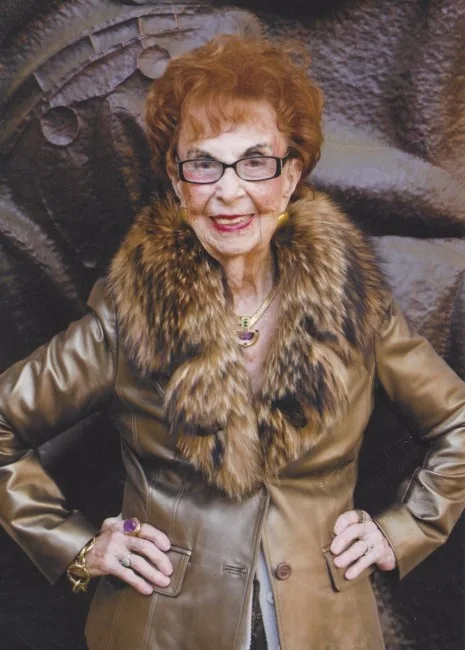
 No postwar Kansas City artist embodied the concept of total artistic creation more fully than Gabriella Polony Mountain. Over the course of more than seven decades, she produced a remarkably varied body of work that included sculpture, tapestry, works on paper, plique-à-jour enamels, repoussé metalwork in copper and silver, and architectural commissions of mosaics, bronze, and stained glass throughout Missouri and Kansas. Although she remained somewhat underrecognized nationally during much of her lifetime, Gaby (her spelling) left an enduring mark across the Kansas City region, placing major art installations inside churches, libraries, civic buildings, universities, and private homes. Generations of Kansas Citians continue to live alongside and be moved by her work, rarely knowing the name of the artist who created it. An example is the baptistry she designed in the early 1960s for St. Ann’s Catholic Church in Prairie Village. In a 2001 Kansas City Star article, Sandy Spaw who joined St. Ann’s with her husband in 1971 said, “I’ve always been so amazed by those mosaics and never knew who did them. They just sparkle. They are simply joyful.” When Gabriella met with a man named Jim Santilli in 2009, he talked of how a pair of doors on a bank in his hometown of Leavenworth had endeared him to the art form of repoussé metalwork as a youth. “I made those doors” Gaby told him. But by the early 2000s, the architects, patrons and neighbors who once commissioned her works, and those who knew her as creator, were gone. Gaby had outlived her own history. But by the time of her death in 2020 at age 102, Gabriella Mountain was becoming recognized as one of the great overlooked artistic figures of the Midwest.
Born Gabriella Banhegyi in 1918 during the waning months of the Austro-Hungarian Empire, she entered a Europe on the brink of enormous upheaval. Nevertheless, her childhood was one of comfort and security in an educated and well-to-do family. Her father, Moritz, was a lawyer, and the family expected Gabriella to follow in his footsteps. She did for a time, studying law for three years until encountering a sculpture so inspiring she decided on the spot she must instead be an artist.
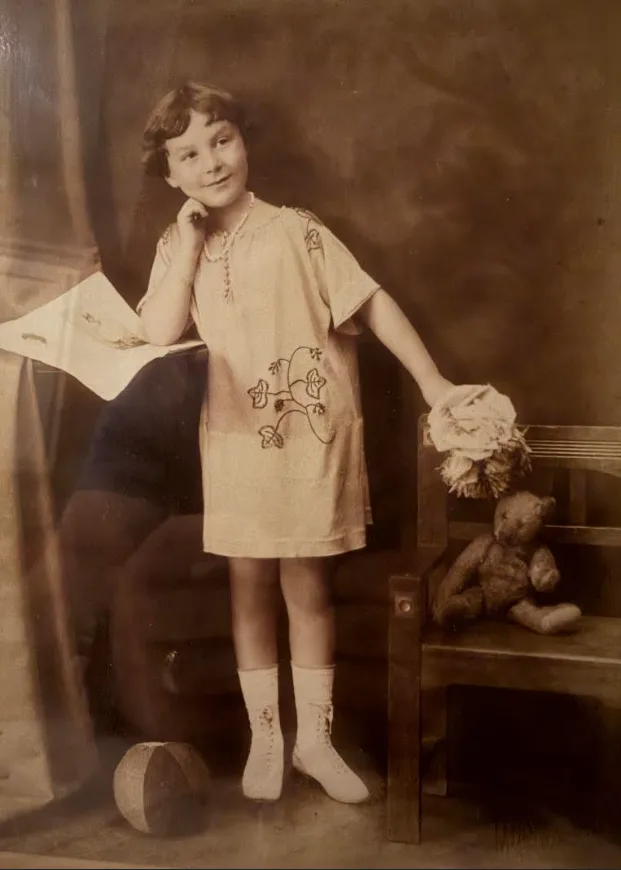 As a child Gaby displayed considerable artistic instincts, beginning to draw seriously around age twelve. Now a young woman, her father readily embraced this renewed calling, and she left Budapest to study art in England. Gabriella would come to realize her father was less interested in fostering her artistic talent than he was in seeing his daughter leave Hungary as the political climate grew darker. For reasons that remain unknown, Gaby left the security of England and returned to study at the Hungarian Academy of Fine Arts in Budapest where she met her future husband, Elemer Polony – an artist who would later paint two murals in Kansas City. This wasn’t Gaby’s first marriage. To legally change her last name and shield her from the ever-increasing dangers facing Hungary’s Jewish population, Gabriella had previously been married into a local Methodist family through her parents’ arrangement. No such precautions were afforded other members of her family. Gabriella later witnessed the arrest of her parents. She never saw them or her brothers again.
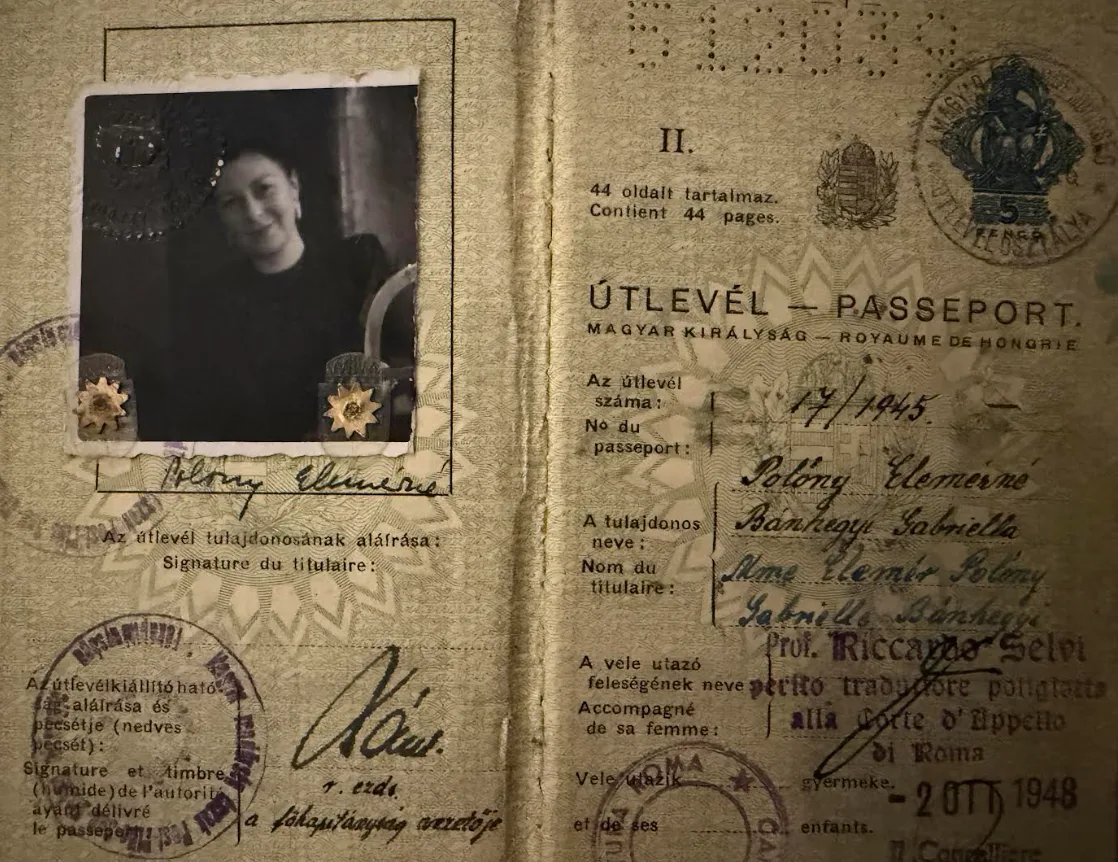 By 1944, war had fully engulfed Hungary, and Budapest became a city under siege, an urban battlefield where Nazi and Russian forces clashed violently. Elemer was conscripted into service by Soviet forces. Gabriella, refusing to live like the rest of the city, hiding day and night in cellars and bomb shelters, took to the hills above Budapest living alone in a dirt-floor cabin with no running water. After a brief Christmas reunion, Elemer found himself pressed into labor by Russian forces building pontoon bridges across the Danube, where he became very ill. Finally some good came their way and they received passports with permission to leave Hungary for Czechoslovakia around 1945 or 1946. “We took our little dog and made our way to the station. It was chaotic and not possible to buy a ticket, so we jumped with the dog onto the caboose of a freight train to Bratislava as it was pulling out.” Gabriella recalled, “We ran into a Russian soldier with a gun, and I started talking to him in Slovak, asking him about his mother and his children, so he wouldn’t kill us. You had to be on your feet, you know?”
They first sought refuge in Czechoslovakia, but after the Communist coup of 1948 they were forced to move again. This time, fortuitously, to Italy where they could continue their studies and Elemer could rest and recover. Here they absorbed the legacies of classical sculpture, ecclesiastical decoration, Renaissance craftsmanship, and European modernism at the American Academy of Fine Arts in Rome. It was during this period that Gabriella was introduced to repoussé at the Accademia di Belle Arti, also in Rome. Her post-war public commissions in bronze and copper are directly connected to skills developed at this academy, an institution founded in the sixteenth century. One has to wonder how many women studied, much less worked, in this male dominated Italian workshop before, or after, Gabriella Polony showed up in the late 1940s.
In 1951, Elemer and Gabriella were sponsored to emigrate to the United States through a refugee resettlement program for Displaced Persons. Originally assigned to California through a Lutheran refugee service, they learned upon arriving in New Orleans that arrangements had been made for them to reunite with Elemer’s brother János in Kansas City. Thanks to a sponsorship from the Westport Presbyterian Church, the couple arrived in KC with their luggage and $120. While working a clerical job with the Graybar Electrical Company so Elemer could be free to paint, Gabriella managed to earn herself the award of a coveted Huntington Hartford Fellowship recognizing exceptional artistic promise. This was followed by a Louis Comfort Tiffany Fellowship in 1955. By the early 1960s she was completing major installations in some of Kansas City’s finest homes. With her marriage to Elemer Polony ended, Gabriella met and married the love of her life, Herman “Rocky” Mountain. The two would be together for 52 years until his passing in 2013. In 1962 Gabriella was recognized with an award from the Art in Architecture program sponsored by the Kansas City chapter of the American Institute of Architects (A.I.A.) for a major installation of copper repoussé. October 26th of that same year saw the dedication of her 220 square foot mosaic mural in the lobby of the Mercantile Bank and Trust Company at 1119 Walnut Street in Kansas City. It was composed of 160,000 pieces of polished wood, marble tesserae, Byzantine glass, stone and metal – and weighed 3000 pounds. In the decades that followed, Gaby finished dozens of commissions throughout the Midwest and completed studio work spanning painting, sculpture, mosaics, stained glass, repoussé, and weaving.
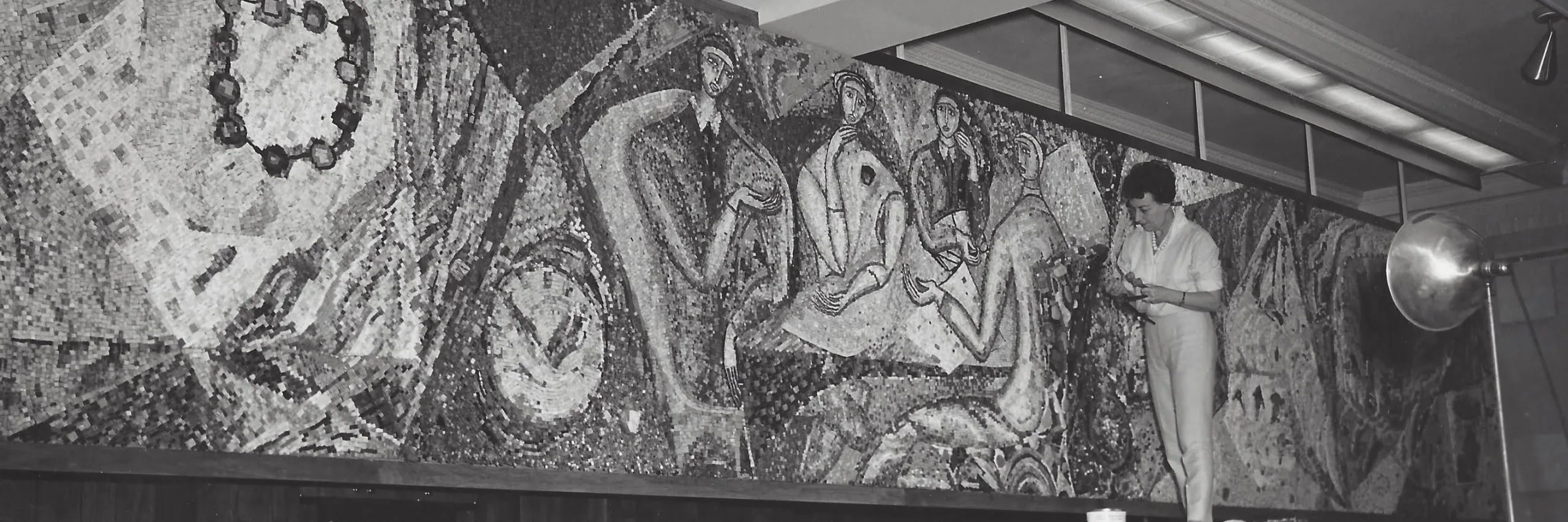
Gabriella’s style defied easy categorization, both as an artist and as a woman. At times her work reflects aspects of European modernism, especially the expressive abstraction associated with postwar sculpture and painting. Elsewhere there are echoes of Byzantine mosaic traditions, folk symbolism, and mid-century biomorphic abstraction. Throughout there is a fascination with rhythm, movement, and spiritual symbolism amid recurring themes of religion, family, and the cosmos. As for her personal style, a young Hungarian Jewish woman studying art in Rome during or shortly after the war was not an everyday occurrence. A woman pursuing the art of sculpting bronze and copper repoussé in close association with the centuries old and male dominated craft guilds, foundries and workshops of Italy was remarkable. There’s nothing to indicate she considered any of this the least bit unusual, despite the physically demanding studio practices of hammering and chasing sheets of bronze and copper. Her grit notwithstanding, in later life, physical limitations finally forced her to adapt. As strength in her hands diminished, she gradually shifted away from metalworking processes and turned increasingly toward weaving and textile arts. Not an artistic retreat, just another reinvention. Her woven works retained the same bold sense of structure, color, and spiritual energy found in her earlier architectural commissions, mosaic plaques, enamel work and mixed media studies.
Visitors to her south Kansas City home frequently described it as a total artwork itself. The residence featured monumental repoussé doors, sculpture, textiles, mosaics, and integrated decorative programs throughout the interior and exterior. The home functioned simultaneously as living space, studio and archive.
By this time, Gaby had witnessed nearly the entirety of the modern era: the collapse of empires, the rise and fall of fascism and communism, postwar American optimism, modernist art and architecture, and the digital age. She continued to make art—and drive her red Corvette—well into her nineties, passing in 2020 at the age of 102 years old.
Paul Dorrell, owner of Leopold Gallery in Kansas City, is quoted as saying, “It’s not surprising that Polony-Mountain did not receive more recognition when she was most active. Art creation in Kansas City when she was at her peak was not nearly at the fever pitch it is now,” he said. “It was not unusual for an undiscovered gem like that to go on working for years in relative obscurity, especially when a person of exceptional talent stayed in a small city like Kansas City. Normally, people of exceptional talent would have moved to New York or Chicago.”
But Dorrell doesn’t think obscurity lessens the intrinsic value of Polony-Mountain’s work.
“What was relevant and well-executed then is relevant and well-executed now,” Dorrell says. “She deserves recognition, and I’m glad she’s finally getting it, because she’s truly a master.”
Gabriella once said, “You can’t roll up a sculpture and take it with you.” So the following list of her projects and accomplishments does not include works, commissions or exhibitions created prior to her emigrating to the United States in 1951.
Gabriella may indeed be one of the most noteworthy Kansas City artists you never heard of.